Transporting and Storing a Fishing Kayak: Weight and Space
How to transport a fishing kayak on a roof or in a truck bed, move it to the water with a cart, and store it so the hull keeps its shape.

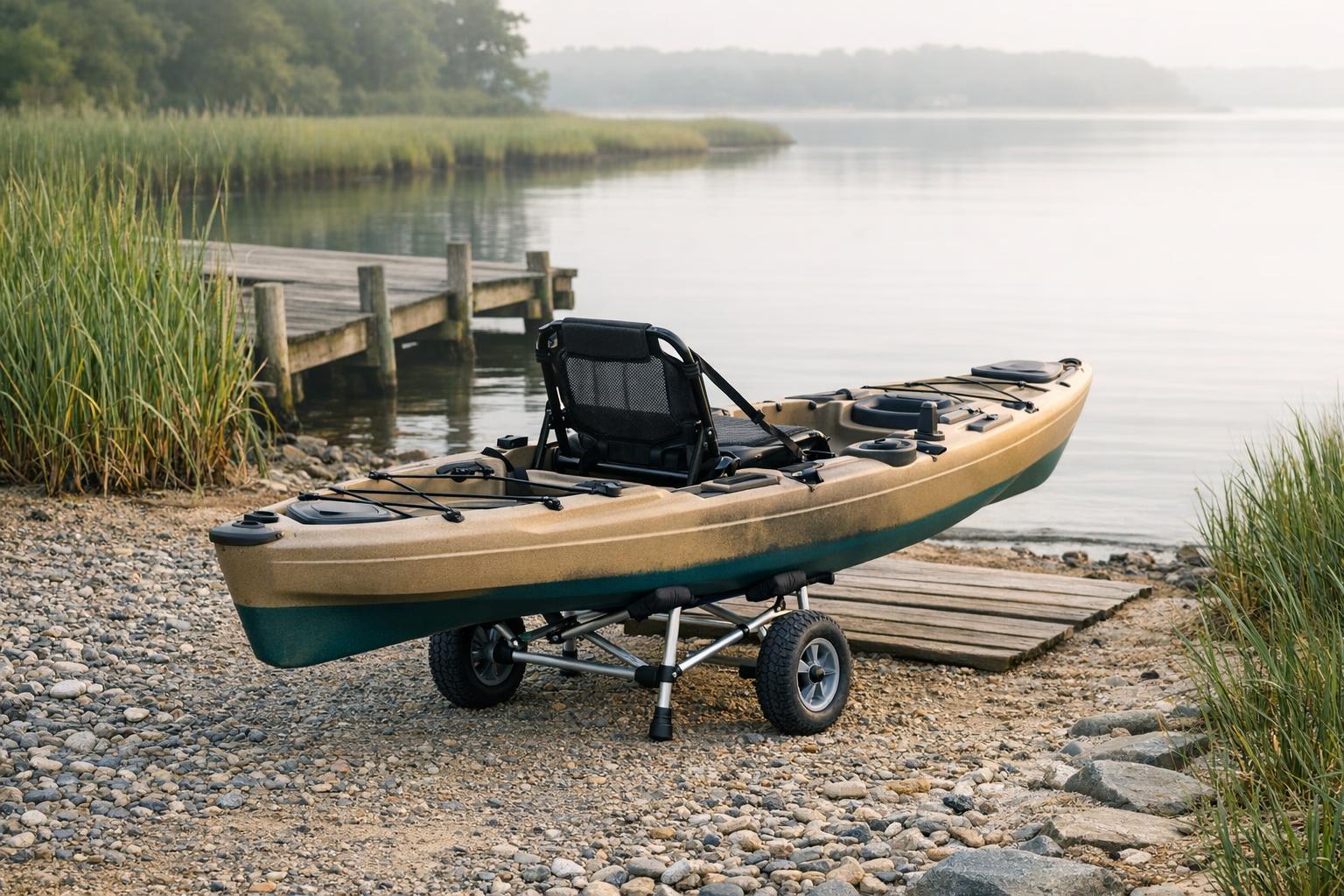
To transport a fishing kayak, carry it on J- or V-cradles on roof bars or in a truck bed, hold it with two cam straps, and add bow and stern lines for highway driving. At home, store it on its side or hull-up on padded supports, out of the sun. The two numbers that decide how easy all of this is are the hull weight and the length on the listing.
Affiliate disclosureAs an Amazon Associate we earn from qualifying purchases made through links on this page. Commissions never change our ratings.
Start with weight and length
A 44 lb kayak and a 121 lb one make two very different Saturday mornings. Check both figures before you buy:
| Kayak | Weight | Length | Lift |
|---|---|---|---|
| Pelican Sentinel 100X Angler | 44 lb | 9 ft 6 in | One person |
| Pelican Catch Mode 110 | 63 lb | 10 ft 8 in | One person, with effort |
| BKC RA220 Angler, 11.5 ft | 78 lb | 11 ft 8 in | Two people or a cart |
| Old Town Sportsman 106 Motor, Ember Camo | 121 lb | 10 ft 6 in | Two people, cart or trailer |
Modular and inflatable kayaks change the equation: the Reel Yaks Raptor Modular, Fin Drive splits into two sections for a trunk or closet, according to the listing.
On the roof: cradles, straps and lines
REI's transport guide recommends kayak racks that cradle the hull in J- or V-shaped forms as the most secure option, two cam straps about 12 ft long, and bow and stern lines, especially on the freeway or in strong wind. Use nonstretch rope with a trucker's hitch if you have no ratchet lines, put a twist in each strap to stop it humming, and stop after about 15 minutes to check that nothing has loosened.
- Check the roof load of your car and rack in their manuals, and count the kayak plus the rack.
- Remember the new vehicle height in garages and drive-throughs.
- Rules on overhang differ: Germany, for example, allows 1.5 m behind the car and asks for a red flag beyond 1 m past the rear lights. Check your state's rules.
From the car to the water: carts
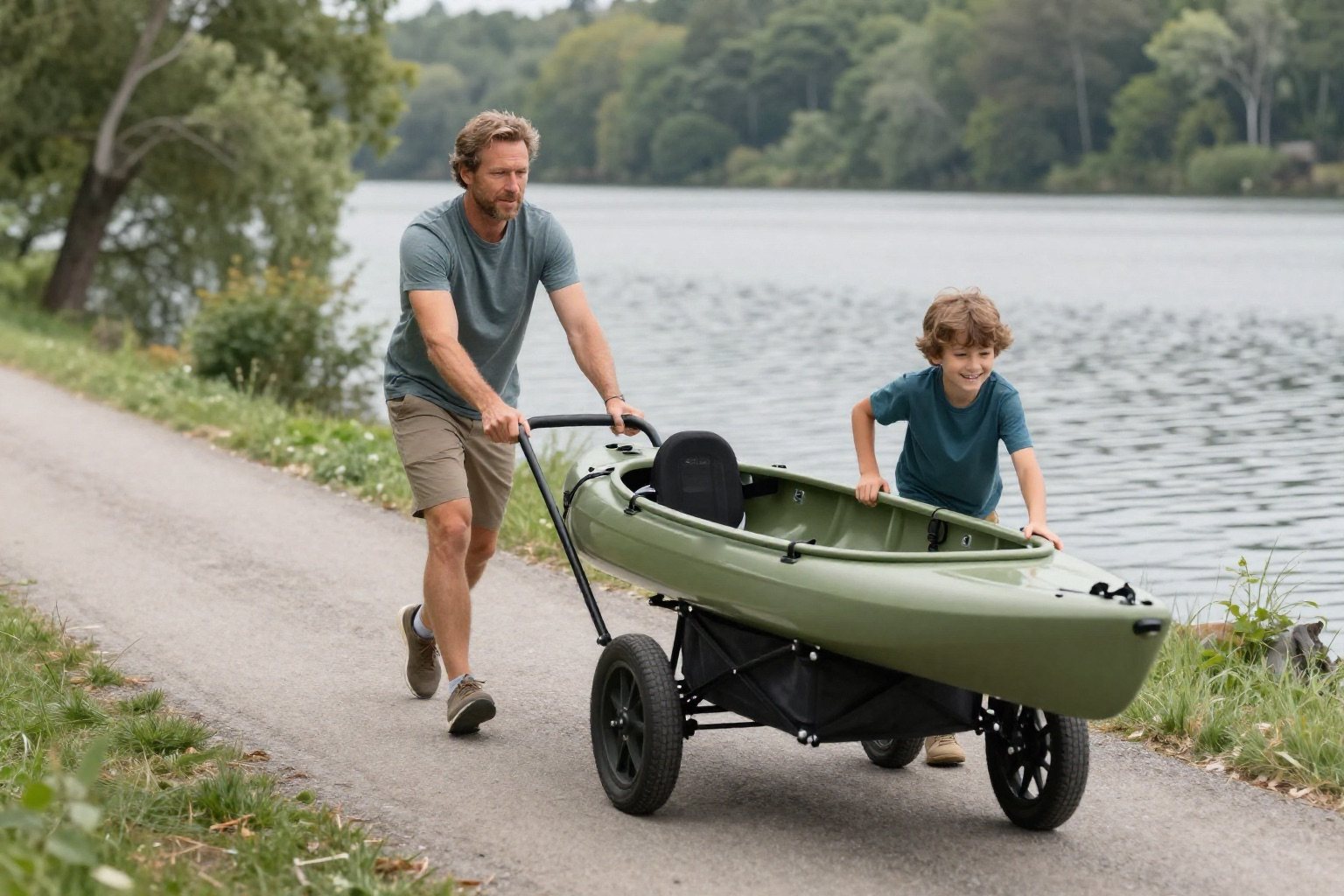
A cart turns a long carry into a short roll. Match its rating to your kayak with gear: the GanFindX Stainless Kayak Cart, 240 lb states 240 lb, and the Pelican Universal Kayak & SUP Cart folds together with wide removable inflatable tires for sand and grass, according to their listings. Strap the kayak to the cart at its balance point so the bow or stern does not drag.
Storing the hull so it keeps its shape
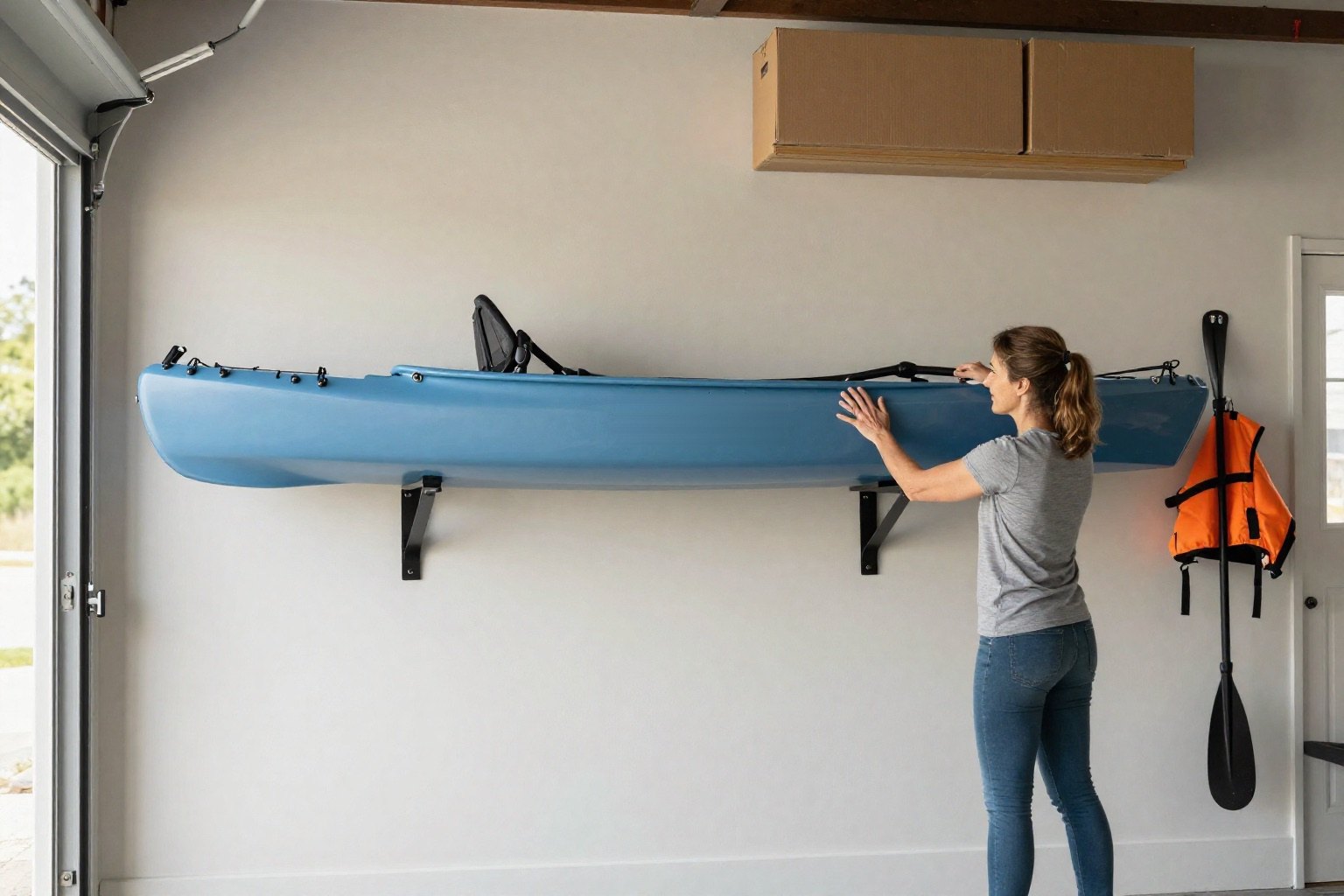
Plastic hulls can deform if they sit on one point. Old Town's owner's manual says kayaks should be stored on their sides or standing on one end, or upside down in slings or cradle-type sawhorses so the decks do not distort. REI adds to support the hull at several points with padded cradles or wide straps, to hang it hull-up if you hang it, and never by the grab loops.
Sun and heat are the other enemy: REI notes UV degrades hull materials and heat can deform them, and Old Town warns never to lay a tarp directly on the boat, because it turns into an oven. Suspend the tarp above the kayak with air underneath, and tie the kayak down if it lives outside.
Off-season checklist
- Rinse the hull and any pedal drive with fresh water, and let it dry with hatches open.
- Remove the battery from a motorized kayak and store it as its maker says.
- Support the hull at two or more padded points, or on its side.
- Keep it out of direct sun; cover it with a suspended tarp outdoors.
- Lock it if it is outside; REI mentions locking cam straps for the roof too.
For overhead storage, the RAD Sportz Kayak Storage Hoist (7.2/10) lifts up to 125 lb on ceilings up to 12 ft, according to the listing. More gear advice in fishing kayak accessories; how much of your kayak's weight is load and how much is hull, in fishing kayak weight capacity.
Our rated picks
The three best-rated models of our best fishing kayaks ranking, from buyer reviews and the listed specs.


Product images: Amazon listings
Frequently asked questions
How do you transport a fishing kayak without a roof rack?
In a truck bed, strapped in (REI notes there are also crossbars made for truck beds), on a trailer, or, for inflatables and modular kayaks, in the trunk. On a car roof, a rack with J- or V-cradles is the most secure option according to REI.
Should a kayak be stored on its side or upside down?
Old Town's manual recommends on its side or standing on one end, or upside down in slings or cradles so the deck does not distort. Avoid resting it flat on its hull on a hard floor for months.
Can I store my kayak outside?
Yes, in shade, off the ground, tied down and under a tarp suspended above it, not wrapped around it. UV and heat are what damage hulls, as REI and Old Town both point out.
How heavy is a fishing kayak to carry?
In our catalog, paddle sit-on-tops weigh 44 to 78 lb according to their listings, pedal and motor models over 100 lb. Compare that with what you can lift onto your roof alone, and plan a cart or a second pair of hands if it is more.
Sources
- REI Expert Advice — How to Tie Down and Transport a Kayak (consulted Nov 2026)
- REI Expert Advice — How to Store a Kayak (consulted Nov 2026)
- Old Town — Owner's Manual (PDF) (consulted Nov 2026)
- German Federal Ministry of Justice (gesetze-im-internet.de) — § 22 StVO: Ladung (consulted Nov 2026)